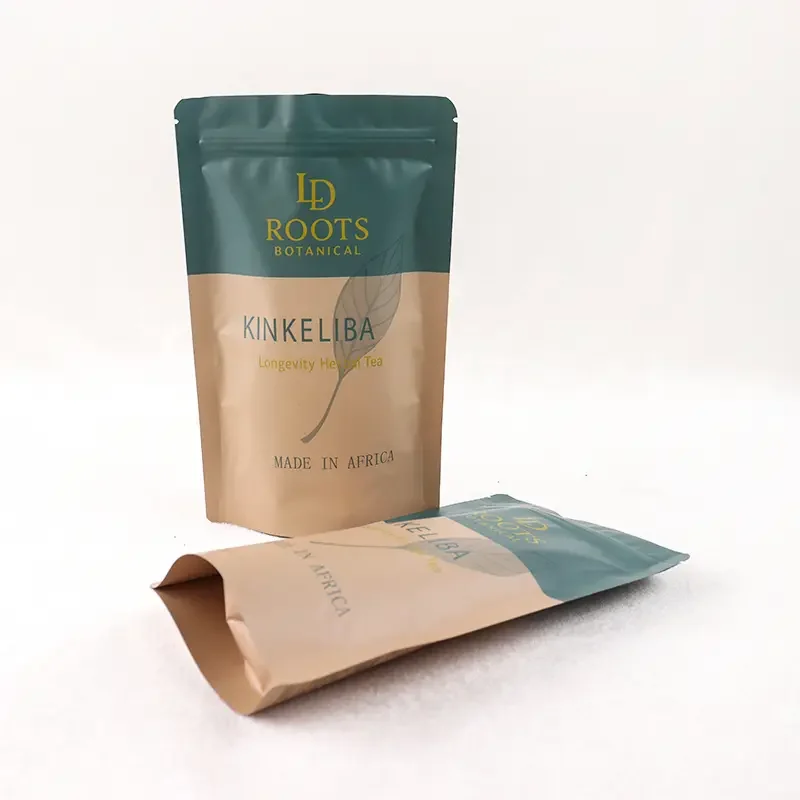
A zipper set 10 mm too low can only be fixed by a reprint. So can a film that’s too thin for the fill. On a 10,000-piece gravure run, that means new printing cylinders and another 7–15 days of production.
Custom plastic zip bags with a logo get quoted correctly when six things are fixed before you ask for a price: fill weight and size, film structure and thickness, zipper type, print method, add-on features and quantity per design. With those six fixed, the first quote is usually the one you order from.
Key takeaways
- Work out the bag size from fill weight and product density. Leave about 25–35 mm above the zipper for the tear notch and top seal.
- Retail food zip pouches typically use a total laminate of 80–150 μm. Go to 150 μm and up only for sharp fills or heavy bulk packs.
- Reverse-print inside a laminate for anything sold on a shelf. Surface print suits short-life or industrial bags.
- Digital printing starts at 1,000 pcs per design. Rotogravure starts at 10,000 pcs per design and gives the lowest unit cost at volume.
What do you need to specify to quote a custom plastic zip bag?
A supplier needs six specs to quote a custom plastic zip bag accurately: fill weight and bag size, film structure with total thickness in microns, zipper type, print method, add-on features and quantity per design. Without the fill weight, any size or price you receive is a guess.
Dimensions: start from the fill, not the bag
A stand-up pouch is a zip bag with a folded bottom gusset that lets it stand on a shelf. A three side seal pouch is a flat bag sealed on three sides and filled through the top. Width × height is measured outside, and the gusset is the depth of the bottom fold opened out.
Mark the zipper position on the spec, plus the header above it for the tear notch and any hang hole. Bag-making tolerance is typically about ±2 mm on width and height; if your filling line is tight, agree it in writing.
We always ask what goes inside, because 250 g of popcorn and 250 g of sugar need very different bags. The sizes below assume medium-density products of about 0.5–0.7 g/ml and include headspace above the zipper.
| Fill | Product example | Format | Suggested starting size | Typical laminate thickness |
|---|---|---|---|---|
| 1 oz / 28 g | Jerky, gummies | Flat zip pouch | 4 x 6 in / 100 x 150 mm | 80–100 μm |
| 2 oz / 57 g | Bath salts, capsules | Flat zip pouch | 4 x 6.5 in / 100 x 165 mm | 80–100 μm |
| 4 oz / 113 g | Spice blends, candy | Stand-up | 4.3 x 6.7 + 2.4 in / 110 x 170 + 60 mm | 100–120 μm |
| 8 oz / 227 g | Trail mix, nuts | Stand-up | 5.1 x 7.9 + 2.8 in / 130 x 200 + 70 mm | 100–120 μm |
| 1 lb / 454 g | Protein powder, pet treats | Stand-up | 6.3 x 9.1 + 3.1 in / 160 x 230 + 80 mm | 110–130 μm |
| 2 lb / 907 g | Powder, rice | Stand-up or flat bottom | 7.5 x 11 + 3.9 in / 190 x 280 + 100 mm | 120–150 μm |
Treat these as starting points. Every bag is made to your product, and we confirm the exact size against your fill weight, density and filling line, usually with a fill test on samples, before artwork is finalised.
Film thickness: microns and mil
A micron (μm) is one thousandth of a millimetre and the standard unit for film thickness. One mil equals 25.4 μm, so a US “4 mil” bag is about 100 μm. Mono-PE zip bags for parts or promo items typically run 50–100 μm; kibble, hardware and bone-in treats usually start at 150 μm.
Thicker isn’t automatically better. Extra gauge adds cost, stiffens the zipper and makes gusset corners harder to seal. Ask for the layer-by-layer build, for example “PET 12 μm / PE 100 μm”, because a total alone lets two suppliers quote very different structures under the same number.
Zipper type
A press-to-close zipper is an interlocking plastic track that closes under finger pressure. The right zipper depends on who opens the bag and how heavy it is.
| Zipper type | Best for | Header space | Relative cost |
|---|---|---|---|
| Single-track press-to-close | Snacks, samples, light fills | Standard | Lowest |
| Double-track press-to-close | Powders, nuts, pet treats | Standard | Slightly higher |
| Slider | Bulk packs of 1 kg and up, older users | More | Noticeably higher |
| Child-resistant | Regulated products only | More | Highest |
A slider earns its cost on a 2 lb pouch opened daily for weeks, not on a 4 oz snack. Buy child-resistant only if your product or market requires it, as some cannabis and household chemical rules do; certification testing such as ISO 8317 or US 16 CFR 1700.20 is done on the finished, filled package, not the zipper alone.

Should your logo be surface printed or reverse printed inside a laminate?
Reverse printing is the safer choice for zip bags with a logo sold on a retail shelf. The ink sits on the inside of the outer PET or BOPP film, sealed between layers, so in normal use it can’t scuff off or touch the product. Surface printing suits short-life or industrial bags where cost comes first.
Reverse printing is printing a mirror image on the inner side of a clear outer film, which is then laminated to a sealant layer. A laminate is two or more films bonded together, such as PET/PE. Surface printing is printing on the outside of a single-layer film, usually protected only by an overprint varnish (OPV).
| Factor | Reverse print (laminate) | Surface print (single film) |
|---|---|---|
| Scuff resistance | Ink sealed between layers | OPV only, can scuff in transit |
| Look | Sharp colours, gloss or matte set by outer film | Flatter, depends on varnish |
| Barrier options | VMPET, AL foil or EVOH layers possible | Limited to the single film |
| Recyclability | PET/PE hard to recycle; BOPE/PE mono-PE possible | Mono-PE film recyclable where collected |
| Relative cost | Higher: extra film and lamination curing | Lower |
Selling in the EU? Plan for the Packaging and Packaging Waste Regulation (PPWR), the EU law that sets recyclability and other rules for packaging on the EU market. It entered into force in February 2025, has applied generally since August 2026, and its recyclability performance requirements phase in from 2030. A reverse-printed mono-PE structure (BOPE/PE) can be recycled where PE film collection exists, so ask for mono-material options now, not at your next redesign.

How many colours can you print, and how is Pantone matched?
Rotogravure printing is printing from engraved metal cylinders, one per colour. Most flexible packaging gravure presses carry 8 to 10 print units, so up to about 8 colours plus white is workable. Digital printing prints CMYK and simulates Pantone shades: fine for most artwork, not for a strict brand colour.
A Pantone spot colour is a premixed ink matched to a numbered reference. Each extra gravure colour adds a cylinder, and two spot colours plus white is often enough for a clean logo bag.
You send Pantone numbers and vector artwork, the ink is pulled as a drawdown on the actual film, and you approve it against your physical chip. A ΔE of 2–3 against the approved drawdown is commonly agreed for brand colours. On clear or metallised film, put white ink under any colour that must look opaque, or a red logo reads as a tinted transparency.
Give your supplier the physical Pantone chip number, not an RGB or hex value. A logo approved on a backlit monitor usually prints a shade darker on film.
What MOQ do custom plastic zip bags need, and how does quantity change unit price?
Printed zip bags start at 1,000 pcs per design with digital printing and 10,000 pcs per design with rotogravure. Below 10,000 pcs per design, digital is the only option. Between 10,000 and about 20,000 pcs, compare total cost on both quotes; above that, gravure usually wins because its cylinders are a one-time cost.
| Option | MOQ | Colours | Setup cost | Best for |
|---|---|---|---|---|
| Digital printing | 1,000 pcs per design | CMYK | No cylinders | Several SKUs, test runs, seasonal designs |
| Rotogravure printing | 10,000 pcs per design | CMYK + Pantone spot | One cylinder per colour, one-time | Steady SKUs, lowest unit cost |
| Eco / biodegradable materials | 30,000 pcs | Per print method | Material-driven | Compostable PLA-based lines |
| Recyclable mono-PE kraft-look | 30,000 pcs | Per print method | Material-driven | EU recyclability planning |
Five flavours at 2,000 each is a digital job; on gravure each design would need its own cylinders and 10,000 pcs. One flavour at 50,000 is clearly cheaper per bag on gravure.
Gravure cylinder cost per bag halves each time quantity doubles, so 10,000 to 20,000 pcs is the biggest price drop in most quotes, and by around 50,000 pcs film and zipper make up most of the cost. Digital unit prices fall only gently. Foil, nylon, a slider, extra colours or a bigger bag push the price up. Reorders usually cost less because cylinders are kept, so confirm how long your supplier stores them.
Can you add a hang hole, tear notch or window to a custom zip bag?
Yes. Hang holes, tear notches, clear windows and round corners can all be added to a custom zip bag at the bag-making stage. Their positions must be fixed on the dieline before printing, because each one changes the space above the zipper and where the artwork can sit.
A round or euro-slot hang hole needs about 25–35 mm of header. A tear notch above the zipper opens the bag cleanly and shows tampering, and round corners stop bags puncturing each other in the carton. A one-way degassing valve is only needed for freshly roasted coffee.
A clear window removes any foil or metallised barrier in that area and lets in light, so we usually suggest skipping it for oxygen- or light-sensitive products such as nuts with a long ambient shelf-life target. The add-ons themselves cost little. Adding one after artwork approval is what gets expensive, since the dieline and sometimes the cylinders change.

What goes wrong on a first zip bag order, and what should you send your supplier?
First-order problems with printed zip bags usually come from four gaps: no fill test, a zipper placed without headspace, thickness chosen by feel, and colours approved on screen. You avoid each one by sending the supplier full product details and approving a physical sample before any cylinders are made.
A bag that won’t close usually had its size copied from a product of different density. Powder poured through the open zipper clogs the track, so ask for an open-bottom bag or a funnel that clears it. Nuts are the classic puncture case: an 8 oz trail mix pouch at 100 μm can lose almonds through the gusset corners in transit, and we usually suggest 120 μm PET/NY/PE as a starting point, confirmed by a drop test.
Paste this into your first email:
- Product: fill weight, product type (powder, granules, liquid or sharp-edged), shelf life needed and storage (ambient, chilled or frozen).
- Bag: target size or a sample bag, plus your preferred format (flat, stand-up or flat bottom).
- Features: zipper type and position, hang hole, tear notch, window, valve; finish (gloss, matte, soft-touch or spot UV).
- Artwork: number of designs and quantity per design, Pantone numbers and vector files (AI or PDF).
- Documents: an EU Declaration of Compliance with migration test reports for Europe, FDA 21 CFR 177 food-contact reports for the US.
FDA 21 CFR 177 is the US regulation that lists polymers allowed in food-contact use. Regulation (EU) No 10/2011 is the EU rule that sets migration limits for plastic food-contact materials, and Regulation (EC) No 1935/2004 is the EU framework regulation that covers all food-contact materials.
Which sample tests should you run before mass production?
A sample test plan for custom zip bags covers five checks: a fill test with your real product, a zipper cycle test, a seal and leak check, a carton drop test and a colour proof in daylight. Running them on samples takes a few days and can save a 10,000-piece reprint.
- Fill samples with your real product at target weight and check the headspace above the zipper.
- Open and close each bag 20+ times, including with product dust on the track.
- Squeeze filled bags or dip them in water to check for leaks, and ask for ASTM F88 seal strength data on the production structure. ASTM F88 is the standard test method for the seal strength of flexible barrier materials.
- Pack filled bags in a shipping carton and drop it from about 1 m.
- Check the printed proof against your Pantone chips in daylight.
How we handle zip bag orders at YLTPACK
YLTPACK has made custom flexible packaging in China for 20+ years. Every zip bag order is printed, laminated and converted in a 6,520 m² cleanroom workshop, checked against an 11-point QC list and produced in 7–15 days after artwork approval, with digital runs starting at 1,000 pcs per design.
The workshop runs 30+ machines, including rotogravure presses, laminators, 11 bag-making machines and slitters, all on water-based inks. The QC list covers zipper function, seals and air-tightness, backed by in-house leak and tensile testing.
We hold ISO 9001, ISO 22000 and GRS certification. FDA-compliant food-contact materials and BPA-free test reports are available on request. Free samples come from our stock (you pay freight), and our free design support turns a sketch or idea into print-ready artwork and a dieline.
Frequently asked questions
Are printed zip bags safe for direct food contact?
It depends on the full structure and your product, so there is no unconditional yes. Suitability rests on the sealant layer, inks, adhesive and the food itself, for example a fatty, acidic or heated fill. Your supplier should provide migration test reports and a Declaration of Compliance under Regulation (EU) No 10/2011 and Regulation (EC) No 1935/2004, plus FDA 21 CFR 177 documents for the US. As the brand owner, you confirm the bag suits your product and conditions of use.
Can a zip bag be recyclable?
Yes, if the whole bag is a mono-PE structure, zipper included, and PE film collection exists where it’s sold. YLTPACK’s MOQ for recyclable mono-PE kraft-look pouches is 30,000 pcs. Multi-material PET/PE and foil bags aren’t recyclable in most current streams.
How long does a custom order take?
7–15 days after artwork approval, plus shipping time. On a first order, allow a few extra days for sample and proof approval.
Can I split one custom zip bag order across several designs?
Yes. With digital printing each design needs 1,000 pcs, so five SKUs can start at 5,000 pcs in total. With gravure, each design carries its own cylinders and a 10,000 pcs minimum.
Do I need print-ready artwork?
No. A sketch, reference image or logo file is enough, and our design team builds the print-ready artwork. Each bag size gets its own dieline, built around your fill and zipper position.
Send us your product, fill weight and target quantity, or the spec of the bag you use today, through our contact page. Within one business day we’ll reply with a suggested structure, gauge and quote for your custom plastic zip bags. We can also send free samples so you can run the fill, zipper and drop tests before mass production.