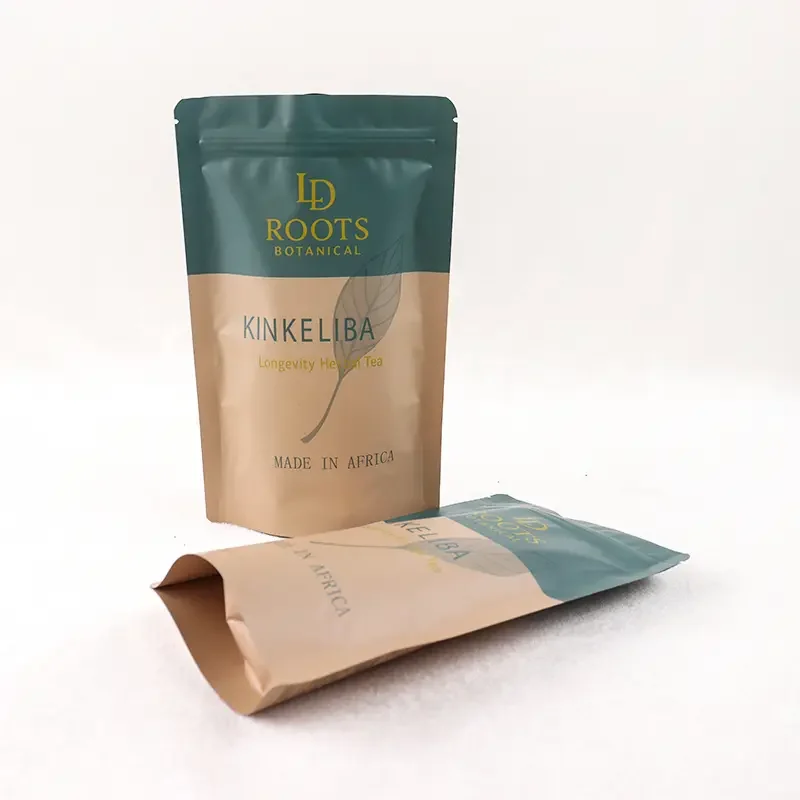
Rice that clumps by week six and coffee that tastes flat a month after roasting usually have the same cause: the bag let in moisture or oxygen. Dry food packaging bags are food-grade flexible pouches, made from single-layer or laminated barrier films, that keep low-moisture foods sealed and fresh through storage, shipping and retail display. This checklist covers format, film, features, printing, compliance and ordering.
- Barrier: Match the barrier to how sensitive the product is. More barrier than the product needs adds cost and makes the bag harder to recycle.
- Format: Stand-up pouches and flat-bottom bags cover most retail dry goods. For 10–25 kg loads, use woven PP or multiwall paper sacks.
- Sustainability: Mono-material PE or PP pouches now work for many dry foods, but their barrier is lower than foil.
- Printing: Digital printing fits short runs and launches with several SKUs. Rotogravure costs less per bag on long runs.
- Compliance: Get the declaration of compliance and migration test reports before you approve production.
What Are the Main Types of Dry Food Packaging Bags, and Which Fits Your Product?
The right bag format for dry food depends on three things: fill weight, how the pack has to look on the shelf, and what your filling line can run. Stand-up pouches and flat-bottom bags cover most retail packs between 50 g and 5 kg. Above about 10 kg, woven polypropylene or multiwall paper sacks take over.
The fill ranges below are typical for the industry. The size you actually need depends on the product’s bulk density.
| Format | Typical fill range | Shelf presence | Filling-line fit | Common products |
|---|---|---|---|---|
| Stand-up pouch | 50 g–2 kg | Stands upright with a large front panel | Premade pouch rotary fillers or hand filling | Snacks, granola, dried fruit, pet treats |
| Flat-bottom bag | 250 g–5 kg | Box-like, five printable panels | Premade, rotary or semi-automatic filling | Coffee, rice, specialty flour, pet food |
| Side-gusset bag | 250 g–5 kg | Tall and narrow, good for stacking | Vertical form-fill-seal from rollstock, or premade | Coffee, tea, flour |
| Three-side-seal pouch | 5 g–500 g | Flat, often hung on pegs | Fast on horizontal or vertical machines | Spices, sample packs, seasoning |
| Bulk sack | 10–25 kg | Warehouse and back-of-house use | Open-mouth or valve sack fillers | Flour, sugar, rice, kibble for foodservice |
For most retail lines, the real decision is between a stand-up pouch and a flat-bottom bag.

Stand Up Pouches for Dry Food
A stand-up pouch is a flexible bag with a folded bottom gusset that opens when the bag is filled, so the pack stands on its own. Stand up pouches for dry food are the default for snacks, granola, dried fruit and pet treats. They cost less per unit than flat-bottom bags and give designers a big front panel to work with.
Flat Bottom Bags for Coffee, Grains and Specialty Lines
A flat bottom bag is a five-panel pouch with a rectangular base and side gussets, so it keeps a box-like shape. You get the front, back, two sides and the base to print on. The squared shape also packs tightly into shipping cartons, with less wasted space than round-bottomed pouches.
Bulk Dry Food Bags for Foodservice and Wholesale Packs
Bulk dry food bags for 10–25 kg loads come in three main types: woven PP sacks, multiwall paper sacks, and heavy-gauge PE bags, typically 150–250 microns thick. Add a PE liner if the product picks up moisture easily, or if fine powders like flour or starch could sift through the weave.

Which Barrier Film Laminates Keep Dry Food Fresh the Longest?
Dry food stays fresh longest when the film’s water vapor and oxygen barrier matches how sensitive the product is, rather than defaulting to the heaviest structure. Foil laminates (PET/AL/PE) give the most protection. Metallized films come close at lower cost. Clear laminates give up some barrier so shoppers can see the food.
The stakes are real. The UNEP Food Waste Index Report 2024 estimated that 1.05 billion tonnes of food were wasted in 2022. Stale or spoiled dry goods are part of that total, and the right film is one of the cheapest ways to reduce it.
A barrier film laminate is a multi-layer film where each layer has one job, such as the print surface, the gas barrier or the heat seal. The layers are bonded with adhesive or by extrusion. The tiers below are relative, not lab values.
| Structure | Moisture barrier | Oxygen barrier | See-through option | Suitable products |
|---|---|---|---|---|
| PET/PE | Medium | Low–medium | Yes | Pasta, candy, short-shelf-life snacks |
| BOPP/CPP | Medium–high | Low | Yes | Crackers, cookies, dry noodles |
| PET/VMPET/PE | High | High | No (window possible) | Nuts, chips, ground coffee |
| PET/AL/PE | Very high | Very high | No | Whole-bean coffee, milk powder, long-shelf-life goods |
| Kraft/PE | Low–medium | Low | Window optional | Rice, tea, granola (add VMPET or AL for more barrier) |
| Mono-PE (EVOH optional) | Medium | Low, medium with EVOH | Yes | Rice, sugar, pasta, pet treats |
Metallized and foil structures win on protection. Clear and mono-material films win on visibility and recyclability.

Moisture and Oxygen Protection: Reading WVTR and OTR
Water vapor transmission rate (WVTR) is the amount of water vapor that passes through one square meter of film in 24 hours, reported in g/m²/24h. Oxygen transmission rate (OTR) measures the same thing for oxygen, in cc/m²/24h. Lower numbers mean better moisture and oxygen protection.
Your spec sheet should cite ASTM F1249 for WVTR and ASTM D3985 for OTR, along with the test temperature and humidity. The same film can show very different numbers at 23°C and at 38°C with 90% relative humidity.
Matching Barrier to the Food
Flour, rice and sugar mainly need protection from moisture. A good PE or BOPP structure usually covers them. Nuts, seeds and whole-grain products are different, because their unsaturated fats oxidize and go rancid, so oxygen barrier matters more. Roasted coffee needs both, plus a way to release the CO₂ it keeps giving off after roasting.
Film Thickness and Puncture Resistance
Retail pouches usually run 80–150 microns in total thickness, with the heavier end used for 2–5 kg fills. Sharp-edged products like dry pasta, kibble and freeze-dried fruit can puncture standard laminates. A 15-micron nylon (PA) layer, as in PET/PA/PE, stops most pinholes without much extra thickness.

Recyclable, Compostable or Conventional Films: Weighing the Trade-offs
Mono-material recyclable pouches work for most dry foods that need moderate barrier, such as rice, pasta and sugar. Compostable films can suit short-shelf-life items, but only after real shelf-life testing. Conventional multi-layer laminates are still the safer choice when a product needs 12 months or more of oxygen protection.
| Film approach | Advantages | Limitations |
|---|---|---|
| Conventional multi-layer (PET/AL/PE, PET/VMPET/PE) | Highest barrier and longest shelf life; sharp print; strong, consistent seals | Layers can’t be separated, so the bag is generally not recyclable in curbside systems |
| Mono-material PE or PP | Can be recycled where flexible-film collection exists; good print; adding EVOH raises oxygen barrier | Lower heat resistance and a narrower sealing window; barrier falls short of foil |
| Compostable (PLA, cellulose-based) | Industrially compostable when certified; attractive story for natural brands | Moderate moisture barrier; shorter shelf life; needs industrial composting facilities, which are not available everywhere |
| Paper-based (coated or lined kraft) | Natural look and feel; paper streams are widely accepted once the coating is thin enough | Needs a coating or liner for any barrier; prints less sharply; tears more easily when wet |
No single option wins on every point. Trade barrier against end-of-life based on the shelf life your product actually needs.
Regulation is driving this choice in Europe. The EU Packaging and Packaging Waste Regulation, Regulation (EU) 2025/40, has applied since August 12, 2026, and its recyclability performance requirements phase in from 2030. For compostability, EN 13432 and ASTM D6400 set the bar. EN 13432 requires at least 90% biodegradation within six months, plus disintegration within 12 weeks under industrial composting conditions.
Make only the claims you can prove. In the US, the FTC Green Guides allow an unqualified “recyclable” label only where collection is widely available. In the EU, Directive (EU) 2024/825 bans vague environmental claims starting September 2026.
Features That Extend Shelf Life and Make Bags Easier to Use
The features that do most for shelf life are a reliable reclosure, a degassing valve for fresh coffee, and a film strong enough to hold a nitrogen flush. Each add-on should fix a known problem, such as stale product after opening, swollen bags or rancidity. Every extra component adds cost and a step on the filling line.
Resealable Food Packaging Bags: Zipper Pouch Options
A zipper pouch is a bag with interlocking plastic tracks below the top seal that let the shopper reclose it. Resealable food packaging bags come in four common types:
- Press-to-close: Single or double track. The standard choice for snacks and granola.
- Slider: Easier to use on 2 kg and larger bags, such as pet food.
- Pocket zipper: Hidden behind a peelable seal, which gives tamper evidence on bulk packs.
- Child-resistant: Required for regulated categories and tested to 16 CFR 1700.20 protocols.
Plan for extra bag height in the dieline, commonly 20–30 mm. The sealing jaws must also clear the zipper.
Valves, Tear Notches, Windows and Hang Holes
A one-way degassing valve lets CO₂ out of roasted coffee and keeps outside air from getting in. Laser scoring gives a clean, straight tear, even through tough PET/PA laminates. A clear window lowers the barrier across its area to the level of the clear film, so keep windows small on oxygen-sensitive products. Round or euro-slot hang holes are for peg displays.
Nitrogen Flushing and Oxygen Absorber Compatibility
Nitrogen flushing pushes oxygen out of the bag before sealing, typically bringing residual oxygen below 2–3% on well-tuned lines. That gain only lasts if the film has high oxygen barrier. Oxygen absorber sachets do a similar job. For nuts and whole grains, either method can add months of shelf life, but confirm compatibility with an accelerated or real-time storage test before you put a shelf-life date on the label.
Next step: Write down your product type, fill weight, target shelf life, sales market and annual volume, then test sample bags with your real product before you commit to a production run. YLTPACK has made custom dry food packaging to customer specifications since 2005. Its production is ISO 22000 certified and FDA compliant, and it offers free samples. To request a sample kit and dieline, email Feynman@yltpacking.com.