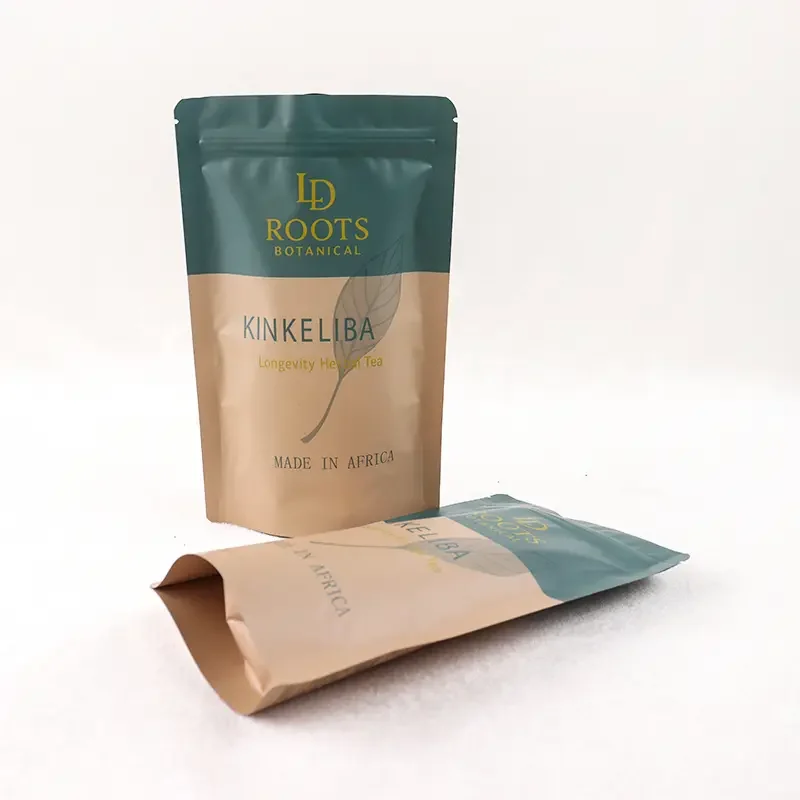
You want your coffee, granola or rice on the shelf in a natural paper bag. You also can’t have it go stale before it sells. A kraft paper stand up pouch can give you both, provided the film layers behind the paper are chosen as carefully as the look.
Kraft paper stand up pouch: is it right for your food product?
A kraft paper stand up pouch is a laminated bag with 50–60 g/m² kraft paper on or near the outside and one or more films inside it. It suits your food when those films match the product. The paper gives look and stiffness, barrier comes only from the film or foil layers, and the inner PE or CPP layer makes the heat seal.
Read any kraft quote as a stack, outside in. An optional 12–20 μm outer film protects the print from scuffs and grease: matte BOPP (MOPP), a matte biaxially oriented polypropylene film, or PET, a stiff clear polyester film. The brown or white kraft paper under it gives the look and the panel stiffness that lets the bag stand. It also soaks up moisture and oil.
The barrier layer does the real work. Metallised PET (VMPET) is PET film with a thin vacuum-deposited aluminium coating, usually about 12 μm. Aluminium foil (AL foil) is a solid 7–9 μm metal layer that blocks light and gas almost completely, and EVOH, an oxygen-barrier polymer, can be co-extruded inside the sealant film.
The sealant is usually LDPE, low-density polyethylene, at 60–120 μm, getting thicker as fill weight rises. This layer touches the food and forms the seals, so it should comply with FDA 21 CFR 177.1520 (olefin polymers) or EU 10/2011.

OTR (oxygen transmission rate) is the volume of oxygen that passes through one square metre of material in a day. WVTR (water vapour transmission rate) is the same measure for moisture, in grams. Lower is better for both.
| Structure | Barrier | Typical OTR / WVTR | Look | Typical foods |
|---|---|---|---|---|
| Kraft/PE | Low | OTR in the thousands; WVTR about 5–8 | Natural paper | Rice, pasta, dry gifts |
| Kraft/VMPET/PE | Mid-high | OTR about 0.5–2 | Paper outside, silver inside | Snacks, tea |
| MOPP/Kraft/VMPET/PE | Mid-high, scuff-proof | OTR about 0.5–2 | Matte, protected kraft | Coffee, granola |
| Kraft/AL/PE | High, light-proof | Below about 0.1 for both | Paper outside, foil inside | Coffee, powders, nuts |
| Kraft/PLA | Low | Poor; not a barrier film | Natural paper | Dry compostable lines |
These are typical ranges from film supplier datasheets, not measurements on your finished pouch: OTR in cc/m²/day per ASTM D3985 at 23 °C, WVTR in g/m²/day per ASTM F1249 at 38 °C / 90% RH. VMPET values depend on metallisation quality and can rise sharply once the film is creased. The Kraft/PE row shows the paper adds look, not protection.
What goes wrong with kraft laminates
Most kraft problems show up on filled samples, not on the quote. These are the points we check first:
- Gusset corners: paper doesn’t stretch, so bottom folds can crack VMPET or foil and leave pinholes. A heavier PE inner layer helps.
- Oily edges: oil from nuts or granola wicks into uncoated kraft at cut edges and seals. A MOPP outer layer stops it, if fill dust stays off the seal area.
- Curl: paper picks up humidity in transit. Tell the supplier your storage conditions and ask how paper moisture is controlled before lamination.
- Seals: delamination usually traces back to adhesive cure time or seal temperature. ASTM F88 is the standard peel test for seal strength, so ask for F88 data on your structure.
- Tear notch: paper tears less cleanly than film. Open a few samples by hand.
Fill three samples with your real product and fold the bottom gusset flat about ten times. Leave them for 48 hours where you store stock. Cracks or white lines at the corners often show up early.
Which foods need more than kraft and PE?
A Kraft/PE pouch suits dry, low-fat foods sold within weeks to a few months, such as rice, beans, pasta and dried herbs for local sale. Coffee, nuts, jerky, powders and anything oily, aromatic or moisture-sensitive typically need a VMPET or foil layer inside the paper for a shelf life of several months, depending on the product.
| Food | Main risk | Minimum structure |
|---|---|---|
| Rice and grains | Pests, dust | Kraft/PE, about 80–100 μm PE |
| Loose tea | Aroma loss, moisture | Kraft/VMPET/PE |
| Roasted coffee | Oxygen, CO₂ release | Kraft/AL/PE with valve |
| Nuts and granola | Rancidity, grease | MOPP/Kraft/VMPET/PE |
| Protein powder | Moisture, caking | Kraft/AL/PE |
Pick the barrier by the product’s main enemy. Shoppers see the paper first. Your product only ever meets the film.
A 250 g bag of whole-bean coffee for specialty retail, with a valve and a three-month target, typically loses freshness within weeks in Kraft/PE, so foil is the right call. A 1 kg bag of basmati rice for a farmers’ market is the opposite. Foil there is money spent on nothing.
What size kraft pouch do you need?
A kraft stand-up pouch size depends on fill weight and product density together. As a starting point, 250 g of nuts or lentils fits a pouch of about 130 x 210 mm with a 45 mm bottom gusset, while light products such as granola or ground coffee usually need the next size up.
The sizes below for kraft paper pouches assume medium-density dry foods. Light products (about 0.30–0.40 g/ml) need a size up, and dense ones such as rice or sugar (about 0.80 g/ml) may fit a size down.
| Fill | Suggested starting size (in, W x H + gusset) | Suggested starting size (mm, W x H + gusset) | Typical products |
|---|---|---|---|
| 3.5 oz / 100 g | 4.1 x 6.3 + 1.4 | 105 x 160 + 35 | Spices, seeds, samples |
| 8.8 oz / 250 g | 5.1 x 8.3 + 1.8 | 130 x 210 + 45 | Nuts, dried fruit, lentils |
| 1.1 lb / 500 g | 6.5 x 10.2 + 2.2 | 165 x 260 + 55 | Rice, beans |
| 2.2 lb / 1 kg | 8.5 x 12.6 + 2.6 | 215 x 320 + 65 | Rice, flour, sugar |
Every bag is made to your product. The exact size is confirmed against your fill weight, product density and filling line, usually with a fill test on samples.
Can kraft pouches have a window, zipper or degassing valve?
Kraft pouches can carry a clear window, a press-to-close zipper, a one-way degassing valve, a tear notch and a hang hole. The window is the one feature that costs barrier: kraft and any metallised or foil layer are cut away there, so only clear film protects the product in that spot.
Buyers often ask for a big window on coffee or nuts. We usually suggest keeping it small, or dropping it for long shelf-life products.
A one-way degassing valve is a small plastic fitting that lets CO₂ out of fresh coffee without letting air in. It’s welded to the inner PE layer, below the zipper and clear of the fill. Stiff paper panels resist closing, so allow about 25–35 mm of headspace above the fill line for the zipper as a typical margin. Slider and child-resistant zippers are available on request.

Printing on kraft: what colour really looks like
Printing directly on brown kraft paper gives darker, duller colour than the same artwork on white film. Reds turn brick-toned and fine type softens into the fibres. A white ink underlay, white kraft or a reverse-printed MOPP outer layer brings the colour back, at some cost to the raw paper feel.
| Print option | Colour accuracy | Paper texture | Scuff and grease resistance | Best for |
|---|---|---|---|---|
| Brown kraft, surface print | Low | Full | Poor, stains with oil and water | Rustic brands, one-colour logos, stamps, labels, handwriting |
| White ink underlay | Medium | Full | Poor | Logos that must stand out on brown |
| White kraft | Medium-high | Full, lighter tone | Poor | Cleaner colour with a paper feel |
| MOPP reverse print over kraft | High | Visible through film | High, ink sealed inside | Brand colours, coffee, oily snacks |
| Plain PET/PE film | Highest, the colour reference | None | High | Bright colours, wet or greasy products, no paper look needed |
MOPP over kraft keeps most of the paper look with film-level colour and stain resistance. Brown surface print only pays off when the rustic look is the point.
Approve colour on a printed kraft proof, never on a screen or a film sample. Paper shade varies between lots, so agree a colour tolerance in writing and ask the supplier to keep a retained sample from your first run.

Are kraft paper pouches recyclable or compostable?
Most kraft paper pouches on the market are neither recyclable nor compostable. Kraft bonded to PE, VMPET or foil is a mixed material that paper mills and plastic recyclers generally don’t accept. Recyclable or compostable paper pouches come from a design choice that covers every layer, including the zipper, valve and inks.
PLA is a plant-based polyester that breaks down under industrial composting conditions. EN 13432 (EU) and ASTM D6400 (US) are the standards for industrially compostable packaging. A kraft/PLA claim holds only if the whole pack is certified, and PLA on its own gives little barrier.
A compostable route for coffee and snacks
A compostable kraft pouch can carry real barrier when a metallised cellulose film sits between the paper and a compostable sealant such as PLA. Metallised cellulose is a wood-pulp film with a thin aluminium coating that typically gives mid barrier, below foil. That can suit snacks or coffee with a shorter shelf-life target, confirmed by shelf tests on your product.
Most of these pouches certify for industrial composting only. Home composting is certified separately, for example under TÜV Austria’s OK compost HOME scheme, and the zipper, valve, adhesive and inks must pass too. Print only the claim your certificate covers.
Kraft-look mono-PE is printed PE film with a paper-like finish and no real paper. It fits the PE recycling stream where collection exists, and YLTPACK’s MOQ for it is 30,000 pcs. A paper-dominant pouch with a thin barrier coating is another route, but ask for a repulpability test before you claim paper recycling. FSC® certification covers responsible sourcing of the paper, not recyclability.
The EU Packaging and Packaging Waste Regulation (PPWR) is the EU law that sets design-for-recycling rules for all packaging. It entered into force in February 2025, has generally applied since August 2026, and its recyclability performance grades apply from 2030, which is likely to make mixed kraft laminates hard to keep in EU retail. If Europe is a long-term market, test mono-material options now and don’t print “recyclable” without proof.
How we handle kraft pouches at YLTPACK
YLTPACK builds each kraft paper stand up pouch to the buyer’s product, fill weight and target shelf life, and confirms structure, size and features with you before production starts. Orders run in a 6,520 m² cleanroom workshop with 30+ machines, including 11 bag-making machines.
We use kraft at 50–60 g, with FSC®-certified kraft on request. Air-tightness (leak) and tensile tests run in our in-house lab, and every order passes an 11-point QC check that includes lamination, seals and zipper. MOQ is 1,000 pcs per design for digital printing, 10,000 pcs for gravure and 30,000 pcs for eco materials. Lead time is 7–15 days after artwork approval, and every order uses water-based inks.
Frequently asked questions
Are paper bags food-safe for direct contact?
In most cases yes, but food-contact suitability depends on the full structure and is confirmed by migration testing for your product. Food touches the PE or CPP sealant, not the paper, and that layer should comply with FDA 21 CFR 177 or EU 10/2011. YLTPACK uses FDA-compliant food-contact materials, with test reports available on request, and BPA-free test reports are also available on request.
Can paper food bags go in the freezer?
In most cases yes, short term, if the bag has a foil or nylon layer and a thick PE inner layer. Condensation during thawing can wet and wrinkle uncoated kraft. For frozen goods, add a MOPP outer layer.
Are kraft pouches suitable for liquids or sauces?
Rarely. Paper gussets flex poorly under liquid weight, so a spout pouch in PET/NY/PE or PET/AL/NY/PE is the safer choice.
Can a kraft pouch go in the microwave?
No, not if it contains foil or VMPET. Even kraft/PE is not made for microwave heating.
What is the smallest order for a test SKU?
1,000 pcs per design with digital printing at YLTPACK. Gravure starts at 10,000 pcs and gives a lower unit cost at volume.
Five questions to ask any supplier before you order kraft stand up bags
Five questions settle most kraft pouch quotes: the full layer structure with thickness, measured barrier, seal strength, colour control on brown paper and the eco claim the exact pouch supports. Paste them into your next email so every kraft paper stand up pouch quote can be compared on the same terms.
- What is the full structure, and what is each layer’s thickness in μm or g/m²?
- What OTR and WVTR does this laminate reach, measured per ASTM D3985 and ASTM F1249?
- What seal strength per ASTM F88 do you target, and how do you leak-test filled bags?
- How do you control colour on brown kraft, and what tolerance applies between batches?
- Which recyclability or compostability claims can this exact pouch support, and with which certificate?
Send us your product, fill weight and target quantity through our contact page, and we’ll reply within one business day with a suggested structure and quote. You can also ask for free kraft pouch samples from our stock (you cover the freight), fill them with your own product and run the gusset-fold test before you commit.