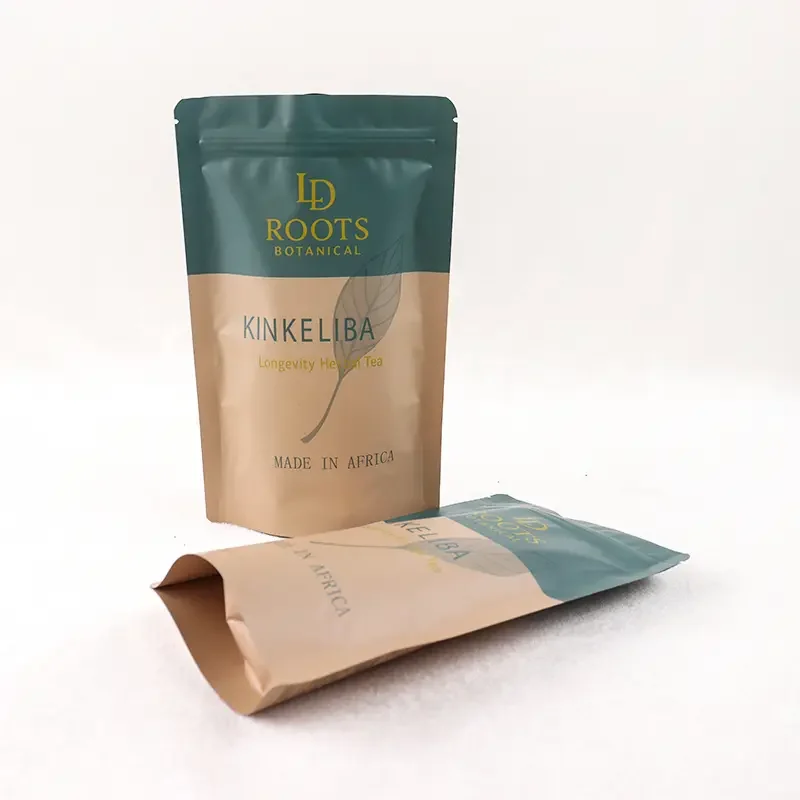
A founder is about to order 5,000 custom mylar bags in four sizes: small mylar bags for 1 g samples and 3.5 g retail packs, a 28 g pack and a 1 kg refill. The spec sheet lists fill weight only. That isn’t enough, because density decides volume and volume decides the bag.
For low-density product such as dried flower or herbs, typical mylar bag sizes start at about 75 x 100 mm (3 x 4 in) for 1 g, 180 x 250 mm (7 x 10 in) for 28 g and 300 x 400 mm (12 x 16 in) for 1 lb. A 1 kg refill needs a gusseted bag of about 300 x 420 mm with 120 mm side gussets. Dense powders and grains need much smaller bags at the same weight.
Above about 2 kg, format and film thickness matter more than exact dimensions. A mylar bag is a pouch made from metallised or foil-laminated PET (polyester) film that shuts out light and slows the passage of oxygen and moisture. Mylar is strictly a trade name for PET film, but buyers use it for any silver or foil barrier pouch.
Key takeaways
- The same 113 g fill can need a bag with nearly three times the face area depending on whether it is dried flower or rice, so measure volume as well as weight.
- Single-use 1–3 g samples usually need only a tear notch, while a zipper adds roughly 25–35 mm to the bag height and extra unit cost.
- Bags for 4.5–5 kg fills typically run 150–200 μm total thickness with a nylon (NY) layer against pinholes, and thicker PE alone doesn’t fix that.
- For retail fills above about 2 kg, a flat bottom pouch or side gusset bag stands and stacks better than a stand-up pouch.
How does product density change the mylar bag size you need?
A mylar bag is sized by the volume of the product, not its weight, and product density in grams per millilitre converts one into the other. Loose, low-density products need two to five times the bag volume of dense powders or grains at the same fill weight, so measure your product’s volume before choosing a size.
Volume in ml equals fill weight in grams divided by density in g/ml. So 28 g of cured flower at 0.17 g/ml takes about 165 ml, while 28 g of protein powder at 0.45 g/ml takes about 62 ml. A quarter-pound (113 g) flower bag needs about 230 x 300 mm, and the same 113 g of rice fits in roughly a third of that face area.

As-filled densities we see in practice run roughly 0.15–0.2 g/ml for cured flower and dried herbs, 0.2–0.35 g/ml for loose-leaf tea and 0.35–0.40 g/ml for whole coffee beans. Protein powder sits around 0.4–0.5 g/ml, rice and grains around 0.75–0.85 g/ml. Your grind, cut and moisture content will shift these typical ranges.
An oversized bag slumps and invites short-fill complaints. An undersized one won’t let the zipper close and stresses the seals. Measuring takes five minutes:
- Weigh out one fill of your product.
- Pour it loosely into a measuring jug.
- Tap the jug three times on the bench to settle it.
- Read the volume and add 20–30% headspace for the zipper and seal area.
What mylar bag sizes fit fills from 1 g to 5 kg?
Mylar bag sizes for low-density products start at about 75 x 100 mm (3 x 4 in) for a 1 g fill and reach about 300 x 400 mm (12 x 16 in) for 1 lb. Powders and grains need far smaller faces at the same weight. Above about 450 g, dense products move into gusseted pouches, because a bigger flat face won’t hold its shape.
Buyers usually order 1 gram mylar bags as sample and trial packs, and the practical minimum face is around 50 x 70 mm. Smaller than that, the bag is awkward to fill by hand and leaves no room for required legal text.

1 oz mylar bags show the density problem most clearly. The common 180 x 250 mm (7 x 10 in) format was built around cured flower, so 28 g of protein powder or ground coffee looks nearly empty in it. The table assumes a press-to-close zipper on every fill of 3.5 g and up.
| Fill | Low density, 0.15–0.2 g/ml (flower, herbs) | Powders, about 0.45 g/ml | Grains, about 0.8 g/ml | Typical format |
|---|---|---|---|---|
| 1 g | 75 x 100 mm (3 x 4 in) | 50 x 70 mm (2 x 2.75 in) | 50 x 70 mm (2 x 2.75 in) | Flat, tear notch |
| 3.5 g (1/8 oz) | 100 x 130 mm (4 x 5 in) | 60 x 90 mm (2.4 x 3.5 in) | 50 x 80 mm (2 x 3.1 in) | Flat, notch or zipper |
| 28 g (1 oz) | 180 x 250 mm (7 x 10 in) | 90 x 130 mm (3.5 x 5.1 in) | 75 x 110 mm (3 x 4.3 in) | Flat with zipper |
| 454 g (1 lb) | 300 x 400 mm (12 x 16 in) | 160 x 230 mm + 80 mm gusset | 140 x 215 mm + 80 mm gusset | Flat or stand-up |
| 1 kg (2.2 lb) | 300 x 420 mm + 120 mm gussets | 190 x 280 mm + 100 mm gusset | 170 x 260 mm + 90 mm gusset | Stand-up or flat bottom |
| 4.5–5 kg (10–11 lb) | 400 x 600 mm + 200 mm gusset | 300 x 450 mm + 140 mm gusset | 250 x 420 mm + 100 mm gusset | Side gusset or flat bottom |
These are suggested starting sizes. The 454 g and 1 kg powder and grain sizes are stand-up pouches with a bottom gusset; the 1 kg low-density size and every 4.5–5 kg size use side gussets, and 2–2.5 kg fills usually go in a flat bottom pouch. Every bag is made to your product, and the final size is confirmed with your fill weight, density and filling method, usually with a fill test on samples.
Do small mylar bags need a zipper or a tear notch?
Small mylar bags holding a single-use 1–3 g sample fill need only a tear notch, which keeps the bag short and cheap. Retail packs of 3.5 g and up that customers open several times should have a press-to-close zipper. Many US state cannabis rules require a child-resistant zipper, so check the rules in your market before ordering.
A tear notch is a small cut in the side seal that lets the bag tear open cleanly by hand. A three side seal pouch is a flat bag sealed on three edges and filled through the fourth, and it’s the usual format for samples. A 2 g tea trial pack mailed in an envelope is opened once, so a zipper there only adds thickness and cost.
| Point | Tear notch only | Press-to-close zipper |
|---|---|---|
| Height added | None; notch sits in the side seal | About 25–35 mm with notch and top seal |
| Unit cost | Lowest | Higher; zipper tape and slower bag making |
| Reclosable | No | Yes |
| Child-resistant option | No | Yes, child-resistant zipper on request |
| Typical use | 1–3 g samples, trial and mailer packs | 3.5 g+ retail packs opened several times |
Our rule of thumb: if the customer finishes the product in one go, the notch wins. If they come back to it, pay for the zipper and order the bag taller than the product alone suggests.
In the US, child-resistant packaging is tested under the protocol in 16 CFR 1700.20, so confirm the requirement for your product before you approve artwork. Place the notch above the zipper track, or customers tear straight through it. Peg displays need a round hang hole.

How thick should large mylar bags be?
A mylar bag for a 4.5–5 kg fill typically needs 150–200 μm (about 6–8 mil) total thickness in a foil laminate with a nylon layer, while small mylar bags for 1–28 g run comfortably at 80–110 μm. Puncture resistance comes mainly from the nylon (NY) layer, so adding more PE alone rarely stops pinholes in a heavy bag.
Metallised PET (VMPET) is a PET film with a thin vacuum-deposited aluminium coating. A foil (AL) laminate uses a solid aluminium foil layer instead, which gives a much tighter barrier.
OTR (oxygen transmission rate) and WVTR (water vapour transmission rate) measure how much oxygen and moisture pass through the film, per ASTM D3985 and ASTM F1249. Typical unflexed values from film supplier datasheets, at 23 °C and 0% RH for OTR and 38 °C and 90% RH for WVTR, are below about 0.1 cc/m²/day and 0.1 g/m²/day for a PET/AL/PE foil laminate. PET/VMPET/PE sits roughly at 0.5–2 cc/m²/day OTR, enough for products sold within a few months, depending on the product and storage conditions.

Big bags fail in two ways. Flex cracking is when the foil cracks at folds as the bag flexes in transit, so the barrier is lost without any visible split; a nylon layer greatly reduces it.
The other is seal or gusset rupture when a full bag lands on a corner. On heavy bags we usually suggest seals of 10–15 mm wide (5–8 mm is normal on small packs), with seal strength checked per ASTM F88.
| Fill range | Typical total thickness | Typical structure | Add when |
|---|---|---|---|
| 1–28 g | 80–110 μm (3–4.3 mil) | PET/VMPET/PE or PET/AL/PE | Foil for longer storage or oxygen-sensitive products |
| 100–500 g | 100–130 μm (4–5 mil) | PET/AL/PE | Matte or soft-touch finish for retail |
| 1–2.5 kg | 130–160 μm (5–6.3 mil) | PET/AL/NY/PE | Sharp or dense product |
| 4.5–5 kg+ | 150–200 μm (6–8 mil) | PET/AL/NY/PE | Handle, wider seals |
The jump from three layers to four matters more than the micron count. On a 3.5 g bag, going past about 110 μm adds cost and slows hand sealing for no real gain.
Fill one sample bag with your real product, seal it and drop it corner-first onto concrete from waist height five times. If the bottom gusset seal opens, you need wider seals or a better seal setting, not just a thicker bag.
Should a 2–5 kg fill go in a stand-up, flat bottom or flat bag?
For retail fills above about 2 kg, a flat bottom pouch or side gusset bag is the better choice, because both stand square, stack in cartons and keep the front panel readable. A stand-up pouch works well up to roughly 1–2 kg. A flat mylar bag makes sense for bulk storage or as a liner inside a bucket or box.
A flat bottom pouch is a box-shaped bag with a rectangular base and two side gussets, also called an 8-side seal bag. A stand-up pouch is a bag with a folded bottom gusset that opens out so it stands on a shelf. A side gusset bag is a tall bag with folded side panels that expand as it fills.
Big mylar bags in stand-up format bulge at the front and tip forward, so your logo curves out of view. For pound-size flower packs, our guide to pound mylar bags for weed covers that specific case.
| Format | Practical fill range | On the shelf | Relative unit cost |
|---|---|---|---|
| Flat mylar bag | Up to about 1 kg retail; any size as a liner | Lies flat, needs a box or bucket | Lowest |
| Stand-up pouch | Up to about 1–2 kg | Stands, bulges when full | Low to medium |
| Flat bottom pouch | About 0.5–5 kg | Stands square, five printable panels | Highest |
| Side gusset bag | About 2–25 kg | Stands when full, handle option | Medium |
If the bag goes on a retail shelf, pay for the flat bottom. If it ships inside a bucket for long-term storage, a flat bag is all you need.

How can you cut the unit cost of a mylar bag order?
The cheapest saving on a mylar bag order is sharing one bag size across several SKUs and changing only the printed design. Dropping the zipper on single-use samples, and choosing metallised PET (VMPET) over foil where the shelf life allows, also cut unit cost without touching how the bag performs.
On big bags, spend on nylon rather than extra PE, because that’s where the puncture resistance comes from.
Digital printing needs no plates, so it suits short launch runs and several designs. Rotogravure needs an engraved cylinder per colour, so it usually becomes cheaper per bag once a design sells reliably at around ten thousand pieces or more, and switching doesn’t change the bag itself.
Where mylar bag orders go wrong between proof and delivery
The mylar bag order problems we see most often have five causes: sizing by weight instead of volume, forgetting zipper height, thin film on heavy bags, a clear window on a light-sensitive product, and powder on the seals. A fill test on samples before artwork approval catches each one cheaply.
The first two are quick fixes. Size from measured volume, and add the zipper’s 25–35 mm to the height before the dieline is drawn.
Sharp product and hidden pinholes
Rice tips, dried meat edges and freeze-dried pieces press against the inner wall in transit and punch through a three-layer laminate, and the bag can look intact while the barrier is gone. Specify PET/AL/NY/PE for these products. Then shake a filled sample in a carton for a few minutes, empty it, and hold the bag up to a bright light to spot pinholes.
Clear windows on light-sensitive products
A clear window means no foil or metallised layer in that area, so light reaches the product. Coffee, tea, herbs and products with natural pigments or oils can lose colour and aroma behind it. If shoppers need to see the product, keep the window small or print a product photo instead.
Powder in the seal zone
Powder on the seal causes slow leaks that often show only weeks later, when a bag goes soft in the carton, because fine particles stop the inner PE layers fusing across the full seal width. Fill through a funnel that reaches below the zipper, wipe the seal zone before sealing, then squeeze-test a few sealed samples.

What to send your supplier before ordering
A supplier can suggest the right mylar bag size, structure and thickness quickly if you send six things: the product, fill weight and measured volume, how you fill and seal, the features you need, the shelf life and target market, and the quantity per design. Copy this checklist into your first email.
- Product: what it is, and if it is sharp, oily or powdery
- Fill weight and volume: per bag, for each size
- Filling and sealing: by hand, impulse sealer or machine
- Features: notch, zipper, child-resistant, hang hole, window
- Shelf life and market: months needed; US, EU or other rules
- Quantities: per design and per size
How we handle mylar bag sizing at YLTPACK
YLTPACK confirms every mylar bag size against your product, fill weight and filling method before production, starting with free samples from our stock for a fill test (you pay only the freight). Digitally printed mylar bags start at 1,000 pieces per design, and production takes 7–15 days after artwork approval.
Gravure printing starts at 10,000 pieces per design and gives the lowest unit cost at volume. Recyclable mono-PE and other eco materials start at 30,000 pieces. Every order is printed with water-based inks.
Bags are made on 30+ machines in a 6,520 m² cleanroom workshop. The in-house lab runs air-tightness and tensile testing, and finished bags pass an 11-point QC inspection that includes seals, zipper and air-tightness. YLTPACK holds ISO 9001 and ISO 22000 certification and supplies FDA-compliant food-contact materials, with test reports available on request. Free design support turns a sketch into print-ready artwork and a dieline.
Frequently asked questions
Are metallised 1g mylar bags enough, or do they need foil?
Metallised PET (VMPET) is usually enough for samples used within a few months, depending on the product. Choose foil (PET/AL/PE) for long storage or for products sensitive to oxygen and light.
Can 1 ounce mylar bags hold 28 g of coffee?
Yes, but the standard 7 x 10 in flower size is too big. Whole beans at 0.35–0.40 g/ml fit in roughly a 90 x 160 mm face. Freshly roasted coffee also needs a one-way degassing valve.
Can I heat seal mylar bags by hand?
Yes, with an impulse sealer that has adjustable time or heat. Heavier bags need a longer dwell, so test the setting on a sample before running a full batch.
Is there a recyclable alternative to foil mylar bags?
Yes: mono-PE (BOPE/PE) with an EVOH or metallised layer gives mid-to-high barrier and can go into the PE recycling stream where it is collected. Its barrier is lower than a foil laminate, so check it against the shelf life you need. If you sell in the EU, watch how recyclability grading develops under the Packaging and Packaging Waste Regulation (PPWR), and expect minimum order quantities for mono-PE to be higher than for standard laminates.
How long from approved artwork to delivered bags?
Custom printed mylar bags typically take 7–15 days of production after artwork approval, plus freight time to your country. That time covers cylinder engraving (gravure only), printing, lamination curing, bag making and inspection. Allow extra time if you want a fill test on samples first.
Send us your product, fill weight per bag and target quantity, and we’ll suggest mylar bag sizes, a structure and a thickness with a quote within one business day. Request free mylar bag samples through our quote form in the sizes closest to your spec, test them with your own product, and pay only the freight. If you’d rather start by email, email your fill weights to Feynman@yltpacking.com with a product photo.