A thicker bag does not keep kibble fresher. A 150 µm kraft-and-PE sack can let in far more oxygen than an 85 µm foil pouch, and the fat in the food can turn rancid weeks before the best-before date.
This guide covers each part of a complete spec for custom pet food bags: format, laminate, print method, closure, compliance documents and order timeline.
Key Takeaways
- Fill weight sets the format: stand-up pouches suit treats and 0.5–2 kg packs. Flat bottom and side gusset bags suit 2–20 kg.
- Fat and shelf life set the barrier: foil laminates give the lowest oxygen transmission. Recyclable mono-PE gives up some protection.
- Run length sets the print method: use digital for short runs and many SKUs, and rotogravure for long repeat runs.
- Get the paperwork before approving artwork: migration test reports and food-contact declarations.
- Delays mostly come from late artwork changes and skipped pre-production samples.
What Is a Pet Food Packaging Bag, and What Does It Need to Protect Against?
A pet food packaging bag is a multi-layer flexible bag that keeps moisture, oxygen, light and fat seepage away from the food. It also carries the brand and has to survive shipping. The bag usually combines an outer print film, a barrier layer and a food-contact sealant layer, and each layer is chosen for a separate job.
The sealant layer, usually polyethylene (PE) or cast polypropylene (CPP), forms the heat seals. The barrier layer is often aluminum foil, metallized PET or EVOH. A barrier film laminate is a structure made by bonding these layers together with adhesive or extrusion.

Barrier Needs by Product Type
Different products fail in different ways, so start the spec with the product.
| Product | Main threat | Barrier priority |
|---|---|---|
| Dry kibble | Fat oxidation, staleness | Oxygen first, then grease |
| High-fat or jerky treats | Grease seepage, rancidity | Grease and oxygen |
| Freeze-dried raw | Moisture pickup, which turns it soft or crumbly | Moisture first, plus light |
| Dental chews | Drying out or mold | Moisture balance |
Fat content explains why kibble is so sensitive to oxygen. Under AAFCO nutrient profiles, adult dog food needs at least 5.5% crude fat. Many retail formulas list 14–18% on their guaranteed analysis, and that fat oxidizes once oxygen gets through the film.
Why Packaging Failures Are Expensive
Rancid kibble smells off, and pets refuse it. Customers usually blame the brand before they blame the bag.
Mold in semi-moist treats can mean pulling a whole lot. Grease that wicks through a paper outer layer leaves dark stains, and retailers reject stained bags on the shelf. Seals that burst in transit damage the bags packed around them. Each of these problems shows up as returns, chargebacks or a buyer asking for a corrective action plan, and all of them cost more than specifying the right material at the start.
Which Bag Style Fits Your Product: Stand Up Pouch, Flat Bottom, Side Gusset or Pillow?
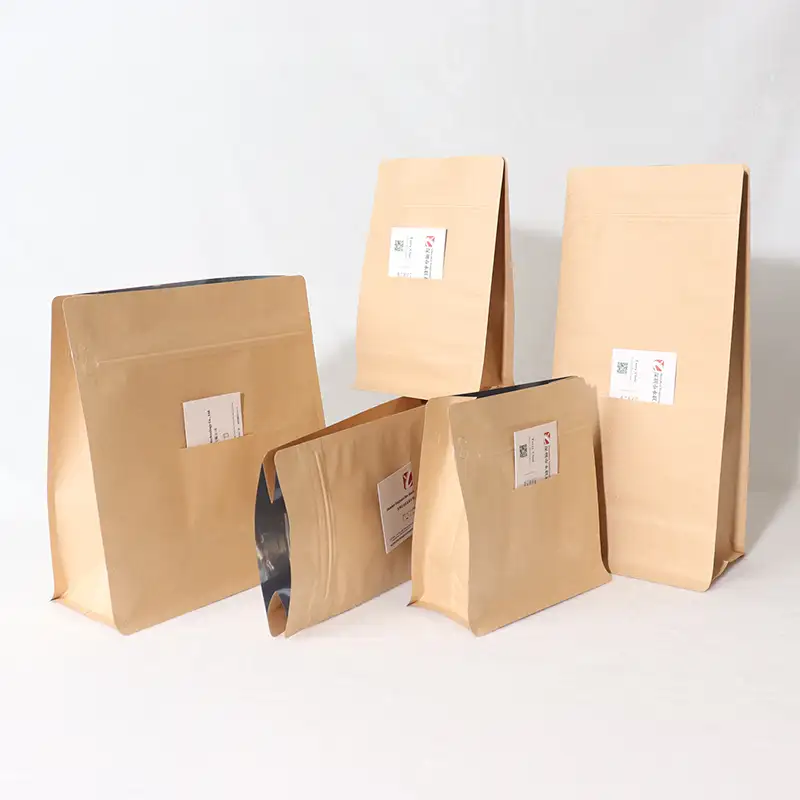
Fill weight and shelf placement decide the pet food bag format. Stand-up pouches suit small packs up to about 2 kg, flat bottom and side gusset bags handle 2–20 kg, and pillow bags work for samples or inner liners. Filling-line compatibility can override all of these.
| Style | Typical fill weight | Print panels | Strengths | Limitations |
|---|---|---|---|---|
| Stand-up pouch | 100 g–2 kg | 2 + bottom gusset | Large front face, easy zipper, runs on common pouch fillers | Becomes unstable and bulges above ~2 kg |
| Flat bottom (box pouch) | 1–15 kg | 5 | Stands like a brick, strong shelf presence | Complex bag-making, more film per bag |
| Side gusset (quad seal) | 2–20 kg | 4 | Good use of pallet space, takes a handle | Less stable on the shelf when partly empty |
| Pillow (back seal) | Samples, liners | 2 | Lowest material use, fast on vertical form-fill-seal lines | Cannot stand, limited display value |
For most retail lines the choice comes down to a stand-up pouch for small sizes and a flat bottom bag for the large sizes.
Stand Up Pouch for Pet Food
A stand up pouch for pet food is a flexible bag with a folded bottom gusset that lets it stand on the shelf. It works well for treats, toppers and trial-size kibble packs. The front panel is large and uninterrupted, which helps for photography. Above about 2 kg the pouch bulges and can tip over.
Flat Bottom Pet Food Bag
A flat bottom pet food bag has a rectangular base and four side panels, so it stands like a carton. With five printable surfaces, you can put feeding guides, guaranteed analysis and the brand story on separate panels. The trade-off is a more complex bag-making process and noticeably more film per bag than a pouch of the same volume.

Resealable Features and Add-ons
Resealable pet food bags rank high on shopper wish lists, but each add-on affects tooling and the schedule.
| Feature | Use | Impact on tooling and lead time |
|---|---|---|
| Press-to-close zipper | Standard reclosure | Minimal, usually stocked |
| Slider zipper | Easy opening on 5–15 kg bags | Added component cost, a few extra days |
| Pocket zipper | Tamper evidence on large bags | Extra bag-making step |
| Laser scoring / tear notch | Clean, straight opening | Laser setup, small cost per bag |
| Handle or window | Carrying, product visibility | Die tooling; a window reduces barrier area |
Barrier Film Laminates: Choosing a Material Structure That Holds Up
The barrier film laminate is the most important specification on a pet food bag order, because it sets shelf life, grease resistance and recyclability. Foil structures give the tightest barrier. Mono-PE with EVOH trades some performance for easier recycling. Every value below is a typical range and should be checked against the supplier’s test data.
| Structure | OTR (cc/m²·day) | WVTR (g/m²·day) | Grease / puncture | Recyclability |
|---|---|---|---|---|
| PET/AL/PE | <0.1 | <0.1 | Excellent / good | Not recyclable in most systems |
| PET/VMPET/PE | 0.5–2 | 0.5–1.5 | Good / good | Not recyclable in most systems |
| BOPP/CPP | 800+ | 3–6 | Fair / fair | Polypropylene stream where accepted |
| Kraft paper/PE | Very high unless lined | 5–15 | Poor without a barrier / good | Limited (mixed material) |
| Mono-PE with EVOH | 1–5 | 1–3 | Good / very good | Designed for PE recycling |
For kibble meant to last 12 months or more, choose foil or metallized structures. BOPP/CPP alone suits only short-life, low-fat products.

Moisture and Oxygen Barrier, Measured
Oxygen transmission rate (OTR) is the volume of oxygen that passes through one square meter of film in a day. Water vapor transmission rate (WVTR) is the same measure for moisture. For both, lower numbers mean better protection.
Ask for OTR results under ASTM D3985 or ASTM F1927 (the humidity-controlled method). Ask for WVTR results under ASTM F1249, and check the test conditions too. EVOH loses barrier at high humidity, so a value measured at 0% RH can look much better than the bag performs in a humid warehouse. Typical total thickness runs 80–120 µm for pouches and 120–200 µm for bags of 10 kg and up.
Recyclable Mono-Material Packaging: Pros and Cons
Recyclable mono-material packaging uses a single polymer family, usually PE, so the whole bag can go into one recycling stream. It is moving into the mainstream, but it is not a direct swap for foil.
| Advantages | Limitations |
|---|---|
| Fits PE store drop-off programs where they exist | Higher OTR than foil, especially in humid storage |
| Matches the EU direction on recyclability | Narrower heat-seal window; filling lines may need temperature and dwell adjustments |
| Supports credible on-pack recycling claims | Stiffness and print gloss can differ from PET-based films |
How Is Kibble Bag Printing Done, and Which Method Suits Your Order Size?
Kibble bag printing uses digital presses for short runs and many SKUs, rotogravure for long repeat runs, and flexography for mid-volume work. Setup cost decides which is economical. Gravure cylinders cost the most to make but give the lowest cost per bag on large orders. Offset printing applies to paper sacks and cartons, not flexible film.
| Method | Economical run | Setup | Color consistency / max colors | Typical lead time |
|---|---|---|---|---|
| Digital | Hundreds to a few thousand per design | None | Good / 7-color gamut | 10–15 days |
| Flexo | About 5,000–30,000 | Photopolymer plates | Good / up to 8–10 | 15–25 days |
| Rotogravure | 10,000+ per design | Engraved cylinders per color | Excellent / up to 10–12 | 25–35 days |
Many brands launch new SKUs on digital and move proven sellers to gravure once volumes settle.
Color Management Across Reorders
Brand colors should be specified as Pantone references, with a ΔE tolerance written into the order. ΔE is a number that measures how far a printed color sits from its target. A ΔE of 2–3 or less is a common commercial tolerance.
Approve ink drawdowns and a press proof on the actual film. The substrate changes the result. The same red looks warmer on kraft, brighter on white PE and darker over metallized film. Keep a signed master sample so each reorder is checked against a physical reference rather than memory.
What Does Food-Contact Compliance Require for Pet Food Packaging?
Pet food packaging compliance requires food-contact-grade materials, migration testing on the finished laminate, and written declarations for every market where the product is sold. The rules differ by region. Without the documents, a retailer or importer can hold the shipment even when the bag itself is safe.
Migration testing measures how much of the packaging’s substances transfer into food under set time and temperature conditions. It covers overall migration and specific substances such as primary aromatic amines from adhesives.
Regulations and Certifications to Ask For
- United States: pet food counts as “food” under the FD&C Act, so packaging materials should comply with FDA 21 CFR Parts 174–178.
- European Union: Regulation (EC) 1935/2004 and Regulation (EU) 10/2011 for plastics formally cover human food. In practice, most retailers and FEDIAF member brands expect pet food packaging to meet the same standard.
- EU PPWR: the Packaging and Packaging Waste Regulation, Regulation (EU) 2025/40, has applied since August 2026 and requires all packaging to be recyclable by 2030.
- Supplier certifications: BRCGS Packaging Materials and ISO 22000 show audited hygiene and food safety controls.
- Printed claims: AAFCO model regulations (US) and the FEDIAF Code of Good Labelling Practice (EU) govern statements such as “complete and balanced” and “grain-free”.
Ordering Custom Pet Food Bags: Minimum Quantities, Lead Times and Approval Steps
Custom pet food bag orders move through eight approval stages, from the product brief to delivery. Minimum quantities depend mostly on print method. Digital runs can start at a few hundred pieces, while gravure usually needs 10,000 or more per design. Lead time is counted from proof approval, not from the first inquiry.
- Share the product spec: product type, fill weight and target shelf life.
- Test stock sample bags with real product.
- Receive and confirm the dieline (the flat layout template with panels, seals and zipper positions).
- Place artwork on the dieline.
- Sign off the digital proof.
- Approve a physical pre-production sample.
- Production with in-line QC checks for seal strength, color and dimensions.
- Packing and shipping.
| Print method | Typical minimum per design | Lead time after proof approval |
|---|---|---|
| Digital | A few hundred to a few thousand pcs | About 10–15 days |
| Flexo | About 5,000 pcs | About 15–25 days |
| Rotogravure | 10,000+ pcs | About 25–35 days |
These are typical ranges and vary by supplier, laminate and add-ons. YLTPACK, a pet food packaging manufacturer founded in 2005, builds every bag to the customer’s spec. It offers free samples, holds ISO 22000 certification and uses FDA-compliant food-contact materials, so laminate testing can start before any order is placed.
What to Put in Your Spec Sheet
- Product: type, fat content, fill weight and target shelf life.
- Bag: style and dimensions (width × height × gusset, in mm).
- Laminate: structure and total thickness in µm.
- Closure and add-ons: zipper type, tear notch, handle, window.
- Finish: matte, gloss, soft-touch or spot UV.
- Volume: SKU count and estimated annual quantity.
- Markets: where the bags will be sold, which decides the compliance documents.
Common Mistakes When Sourcing Pet Food Bags, and How to Avoid Them
The most common pet food bag sourcing mistakes are choosing a format before testing real fill volume and under-specifying barrier for high-fat recipes. Skipping physical tests is another. Most of these mistakes show up only after the first production run, when fixing them means new tooling or a full reprint.
- Sizing on paper: kibble density varies by recipe and kibble shape. Fill a stock sample with real product before you lock dimensions.
- Too little barrier: a structure that works for a 9% fat recipe may fail for a 20% fat one. Match OTR to fat content and shelf life.
- No drop or seal testing: run drop tests on filled bags and check seal strength (ASTM F88 is the common method) before full production.
- Approving color on screen: monitors do not show how ink looks on metallized or kraft film. Insist on a physical proof.
- Unverified “recyclable” claims: a recyclable label must match the collection rules in each market where the bag is sold.
FAQ
Are recyclable pet food bags as protective as foil laminates?
Not fully. Mono-PE with EVOH comes close for most dry foods kept at moderate humidity. Foil laminates still give the tightest oxygen barrier for high-fat recipes and long shelf lives.
How long does dry pet food stay fresh in a barrier bag?
It depends on three factors: fat content, the film’s OTR, and whether the bag is nitrogen-flushed to lower residual oxygen. Storage temperature and humidity also matter. Confirm the shelf life with accelerated storage testing on your actual recipe.
Can several flavors share one bag size in the same order?
Usually, yes. Digital printing handles many designs on the same bag size with no setup cost. Gravure needs a separate cylinder set for each design.
Do pet food bags need to be food-grade?
Yes, in practice. In the US, pet food is regulated as food, so FDA food-contact rules apply. In the EU, retailers and brands generally expect the same standard, so request declarations and migration reports.
Planning Your Next Pet Food Bag Order
Make the decisions in this order: format, barrier, print method, compliance, timeline. Then fill in the spec sheet. Request physical samples in two candidate laminates and run a fill-and-drop test with real product before committing to a full production run.
Ready to test? Email your spec sheet to Feynman@yltpacking.com to request free YLTPACK samples in your shortlisted bag styles and laminates. Bags are made to your sizes, closures and artwork.