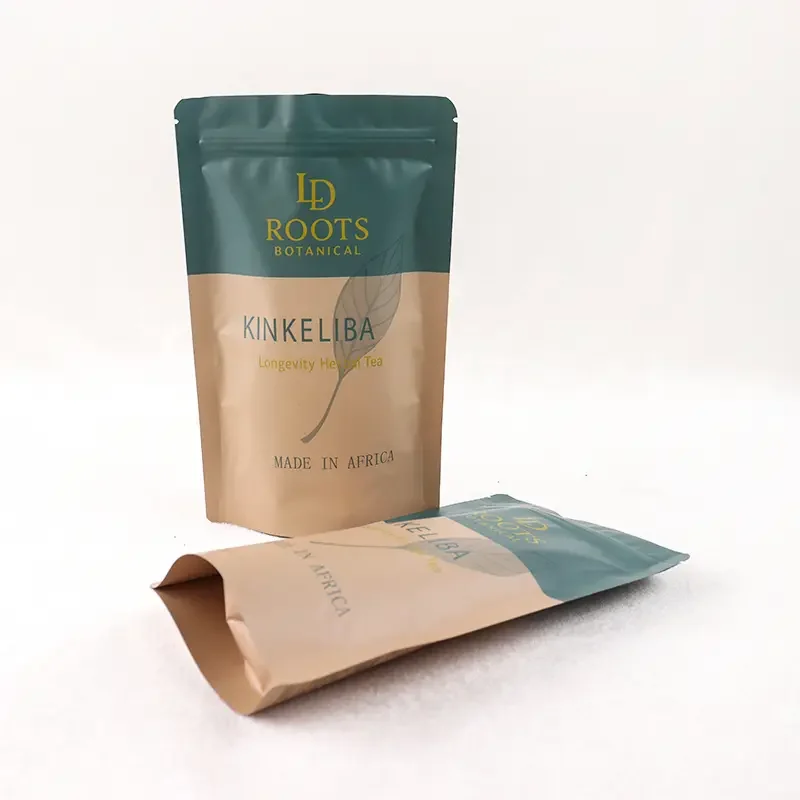
Grease in the 10 mm top-seal band just above the zipper is one of the most common reasons a jerky pouch fails before its best-by date. A greasy strip brushes that band during filling, and the top seal looks closed but hides a hairline channel. At about 0.80 water activity, that channel lets oxygen in, and mould often follows.
Good dog jerky treat packaging needs four things: a high-barrier laminate (foil, or a strong VMPET or EVOH structure), a clean seal zone, a zipper matched to the bag weight, and label space planned around the seals.
Key takeaways
- At about 0.80 water activity, a foil laminate such as PET/AL/PE, used with an oxygen absorber you source separately, is the safest starting point for a long best-by date. Your own storage test confirms that date.
- A clear window cuts oxygen and light protection more than any other design choice on a jerky pouch.
- Six flavours at 3,000 pouches each fits digital printing, where minimums typically start in the high hundreds to low thousands per design, with no cylinder cost.
- On a 7 x 10 in stand-up pouch, roughly 40% of the front panel can’t be used for key text.
Can a mono-PE jerky pouch be labelled recyclable?
A mono-PE pouch is a bag made entirely from polyethylene layers, usually a biaxially oriented PE (BOPE) outer film and a PE sealant, so it can go into PE film recycling. You can print “recyclable” on a mono-PE jerky pouch only after the whole structure, including the EVOH barrier, inks and zipper, has been assessed for the market you sell in.
“Mono-PE” on the spec sheet isn’t enough for the recycling arrows. How2Recycle issues a label only after reviewing your exact structure, and its flexible-film options keep changing, so check what is current before you finalise artwork. APR and RecyClass guidance generally tolerates a thin layer of EVOH (ethylene vinyl alcohol, a clear oxygen-barrier polymer), typically a few percent of the structure and often with a compatibiliser.
In the US, recycling claims fall under the FTC Green Guides, and California’s SB 343 restricts both the word “recyclable” and the chasing arrows. In the EU, the Packaging and Packaging Waste Regulation (PPWR) entered into force in February 2025 and has applied since 12 August 2026, with recyclability grades following through delegated acts on the way to 2030. This isn’t legal advice; have your regulatory adviser confirm the wording before anything goes to print.
Then there’s the barrier catch. EVOH loses oxygen barrier as humidity rises, and 0.80 aw jerky keeps the inside of the bag humid, so a mono-PE pouch may not hold an 18-month date. Only a storage test will tell you.
Recyclable mono-PE pouches also usually carry a higher MOQ, often above an 18,000-bag, six-flavour launch. We usually suggest launching in a proven laminate and moving the winning flavours to mono-PE once volume justifies it.

What barrier does dog jerky treat packaging need at 0.80 water activity?
Jerky at about 0.80 water activity stays stable through its formulation and an oxygen absorber, while the pouch keeps oxygen, moisture and light out for the whole shelf life. For an 18-month best-by target, the realistic starting point is a foil laminate (PET/AL/PE), with metallised PET only if your storage test supports it.
Water activity (aw) is a measure of how much free water in a food is available to microbes, on a scale of 0 to 1. At 0.80, jerky stays soft and chewy, but it depends on low oxygen to stay free of mould.
Barrier comes from the right layer, not from thickness. A 150 μm PE film still passes far more oxygen than the 7–9 μm of aluminium foil inside a standard PET/AL/PE pouch.
PET/AL/PE is a three-layer laminate of a printed polyester (PET) outer, aluminium foil (AL) and a polyethylene (PE) sealant. Metallised PET (VMPET) is PET with a thin vacuum-deposited aluminium coating; it costs less than foil but lets more through.
The figures below are typical OTR (oxygen transmission rate, per ASTM D3985, typically at 23 °C) and WVTR (water vapour transmission rate, per ASTM F1249, commonly at 38 °C and 90% RH) ranges, not test results for your bag.
| Structure | Typical OTR (cc/m²/day) | Typical WVTR (g/m²/day) | Look | Fit for 0.80 aw, long date |
|---|---|---|---|---|
| PET/AL/PE | under 0.1 | under 0.1 | Opaque, printed or metallic | Strongest option |
| PET/VMPET/PE | about 0.5–2 | about 0.5–1.5 | Opaque, shiny inside | Borderline, test it |
| MOPP/Kraft/VMPET/PE | about 1–3 | about 0.5–2 | Kraft look | Shorter dates |
| Mono-PE with EVOH | about 1–5 dry, higher when humid | about 1–4 | Matte or gloss | Test before use |
| PET/NY/PE (clear) | tens of cc | about 3–6 | Fully clear | Not for long dates |
Foil is the only structure in the table that leaves real margin for a fatty, 0.80 aw product. An 8 oz stand-up pouch typically lands around 100–130 μm total thickness and a 2 lb bag needs more, but that extra thickness buys puncture resistance, not barrier. Your storage test and your food safety adviser confirm the date.
Greasy or mouldy: what each failure means
When a buyer tells us the jerky “went greasy”, it’s usually oxidised fat. Oxygen and light turn the fat rancid, and the smell changes first.
Mould is a different problem. It comes from oxygen left in the headspace or getting in through leaks. Let batches cool to room temperature before sealing, because warm jerky releases moisture that condenses on the film.

An oxygen absorber is a small sachet, typically iron-based, that takes up the oxygen sealed inside the bag. On a leaky or low-barrier film it can saturate within weeks. Size it with your absorber supplier against your bag’s headspace.
Can a clear window go on a jerky pouch without losing barrier?
A clear window on a jerky pouch always costs some barrier, because the window area has no foil or metallised layer. Oxygen and light pass through the window at many times the rate of the rest of the bag, so on a long best-by date the window usually limits shelf life. Soft-touch matte and spot gloss don’t affect barrier.
Light through the window speeds up the rancid smell, and fat smears on the inside of the film look bad on shelf. A clear high-barrier EVOH film narrows the oxygen gap at extra cost. It still sits below foil, though, and does nothing for light.

Soft-touch matte is a velvety coating that feels good in the hand but shows fingerprints and grease marks on dark colours. A spot gloss logo stands out sharply against it.
If you really want a window, keep it small and use it only on short-date SKUs. On long-date lines, we usually suggest real product photography on a foil bag. It sells the jerky without the barrier penalty.
What Delta E tolerance can you expect for Pantone 1585C on kraft-look film?
A Delta E tolerance for Pantone 1585C is not a fixed guarantee. It is a written per-order target against a signed master sample, measured with a spectrophotometer under the D50 illuminant and checked visually in a D50 booth. Expect it tighter on gravure with a mixed spot ink and looser on digital, because 1585C sits near the process gamut edge.
On a MOPP/Kraft/VMPET/PE laminate, the ink is reverse-printed on the inside of the matte OPP (MOPP) with kraft right behind it. Without a white ink layer underneath, 1585C comes out muddy, closer to rust. A printed kraft effect on white film keeps the orange clean, and it also works on mono-PE.
Delta E (ΔE) is a number that tells you how far a printed colour sits from its target. Spot-colour targets around ΔE 2–3 are typical in the industry, but agree the figure only after a proof on your actual film.
Don’t write “match the Pantone” on the purchase order. Write the ΔE figure, the D50 check and the signed master sample. Matte lamination also reads a little softer than the coated Pantone C swatch, so approve against a printed sample, not the swatch book.
Rotogravure is a printing method that uses one engraved cylinder per colour, so a true 1585C spot ink can be mixed. Digital printing builds colour from process inks with no cylinders, and 1585C usually lands slightly duller. If you launch digitally and move winners to gravure, approve both against the same master.
Will a press-to-close zipper hold jerky grease, or do I need a slider?
A press-to-close zipper still recloses with some jerky fat on the track. The bigger risk is grease or meat fibre caught in the top heat seal during filling, which leaves leak channels. For a 2 lb bag, choose a slider zipper, because the heavy fill pulls press tracks apart and customers struggle to line them up.
The zipper only recloses. The hermetic seal is the top seal above it, which the customer tears off at the tear notch. A slider zipper is a zipper closed by a small plastic pull that runs along the track. It adds unit cost: worth it on a 2 lb bag, overkill on a 3 oz one.
The leak-test failures we see most often start at the filling table. A strip of jerky drags across the seal zone, the jaws close over a film of fat, and a seal that looks fine bubbles under water.
Use a funnel or scoop that keeps product off the seal zone. Ask about a metallocene LLDPE sealant, which usually seals through light grease better than standard PE, or wider seal bars on the co-packer’s sealer. Confirm the choice on a fill test, then check seal strength per ASTM F88 and run a bubble leak test per ASTM D3078 on your own line.
Sharp, dried corners can rub pinholes through the gusset folds of 1–2 lb bags in transit; a nylon (NY) layer, as in PET/AL/NY/PE, usually stops it. Leave enough headspace above the fill line for a slider to close. Our guide to dog treat pouch styles, sizes and materials covers the format choices.
Run your fill test with your fattiest batch, not the neat lab batch, and don’t wipe the seal area. Fill, seal and leak-test those bags the way your co-packer’s line will.
How much of a 7 x 10 in jerky pouch front can you actually print on?
On a 7 x 10 in (178 x 254 mm) stand-up pouch, the top seal, tear notch and zipper typically take the top 45 mm (about 1.75 in). Side seals take about 15 mm each and the bottom gusset curve 25–35 mm. That leaves a safe front area of roughly 148 x 175 mm, so the guaranteed analysis and feeding guide belong on the back.
A stand-up pouch is a bag with a folded bottom gusset that opens out so it stands on the shelf. Once filled, the gusset bulges and anything printed low tilts away from the shopper.
Keep the logo, product name, species (“for dogs”) and net quantity inside the safe area. Pet food labelling rules generally place net quantity in the lower 30% of the principal display panel, which overlaps the gusset curve, so set it just above the curve and confirm placement with your regulatory adviser or state feed control official.
The back panel takes the guaranteed analysis, ingredients, treat statement and feeding guide. The gusset bottom is a good spot for a barcode or a flavour colour band.

A flat bottom pouch is a box-shaped bag with a flat base and two side gussets that stands like a carton and suits heavier fills. The starting sizes below assume loose jerky strips at about 0.25–0.35 g/ml. Dense bites need smaller bags.
| Fill | Format | Suggested starting size (in) | Suggested starting size (mm) | Closure |
|---|---|---|---|---|
| 3 oz (85 g) | Stand-up | 5.1 x 7.9 + 2.8 gusset | 130 x 200 + 70 | Press-to-close, hang hole |
| 6 oz (170 g) | Stand-up | 6 x 9 + 3.1 | 152 x 229 + 80 | Press-to-close |
| 8–10 oz (227–283 g) | Stand-up | 7 x 10 + 3.5 | 178 x 254 + 90 | Press-to-close |
| 1 lb (454 g) | Stand-up | 8.5 x 12 + 3.9 | 216 x 305 + 100 | Press-to-close or slider |
| 2 lb (907 g) | Flat bottom | 5.9 x 13.4, 3.9 side gussets | 150 x 340, 100 side gussets | Slider |
Every bag is made to your product: the exact size is confirmed with your fill weight, product density and filling line, usually with a fill test on samples. For other treat types, see our pet treat bag size guide.
Six flavours at 3,000 each print digitally and can still make a June 15 launch
Six flavours at about 3,000 pouches each suit digital printing, where minimums typically start in the high hundreds to low thousands per design, with no cylinder cost. With artwork approved by March 1 and 7–15 days of production, sea freight to the US typically lands the pouches in late April, leaving several weeks for filling plus some slack.
Gravure minimums are set per design and run far higher. Six flavours can mean several times your 18,000 units of demand, plus six cylinder sets you write off if two flavours fail.
Digital costs more per unit but leaves far less obsolete stock. Keep all six flavours on one size and one structure to hold the price, and move proven sellers to gravure once reorders clear the gravure minimum.
| Step | Typical time | Target date |
|---|---|---|
| Samples, fill test, proofs | 2–3 weeks | Done by late February |
| Artwork approval | Your sign-off | March 1 |
| Production | 7–15 days after approval | Ex-works by about March 16 |
| Sea freight, customs, trucking to US | Typically 4–7 weeks door to door, West Coast shorter | Late April |
| Co-packer filling, retailer DC | Per your co-packer and retailer | Before June 15 |
Treat this timeline as a plan, not a guarantee. Artwork changes after approval restart production, and port congestion, a customs exam or a full co-packer schedule can each add a week or more.
Budget two to three weeks of slack and book your co-packer slot as soon as artwork is approved. Finish proofing either side of Lunar New Year, which usually falls between late January and mid-February. If sea freight runs late, air freight typically takes about a week, at a much higher cost per kilo.
Paste these details into your first supplier email:
- Product: jerky type, water activity, fat level, and whether you use an oxygen absorber
- Fill: net weight per flavour and quantity per SKU
- Look: Pantone references, finish, window or no window
- Line: hand fill or machine, and your co-packer’s sealer type
- Dates: artwork approval date, delivery port, launch date
At YLTPACK, jerky pouches are leak-checked and inspected before they ship
YLTPACK prints and converts dog jerky treat packaging in a 6,520 m² cleanroom workshop with 30+ machines, including 11 bag-making machines. Our in-house lab runs air-tightness (leak) and tensile tests, and every order passes an 11-point QC inspection that covers seals, zipper, air-tightness and odour among other checks.
We have 20+ years in flexible packaging and hold ISO 9001 and ISO 22000 certification. We use FDA-compliant food-contact materials, with test reports and BPA-free test reports available on request. All production uses water-based inks.
Our digital printing MOQ is 1,000 pcs per design and our gravure MOQ is 10,000 pcs, so six flavours on gravure would mean 60,000 bags. Recyclable mono-PE pouches start at 30,000 pcs. Free samples from our stock let you run a fill test first; you pay the freight.
Frequently asked questions
Do I need an oxygen absorber in a jerky pouch?
In most cases, yes, for jerky around 0.80 aw. A high-barrier film keeps new oxygen out, but the absorber removes the oxygen already sealed in the headspace. Source and size it with an absorber supplier against your bag’s headspace.
Can I use a plain kraft paper bag with no barrier film?
No. Jerky fat soaks through paper and leaves spots, and paper alone gives almost no oxygen or moisture barrier. A kraft look with a VMPET or foil layer inside is the usual compromise.
Will sharp jerky pieces puncture the pouch?
They can, especially at the gusset folds on 1–2 lb bags. Adding a nylon layer, as in PET/AL/NY/PE, is the usual fix and adds a modest amount to unit cost.
Are the inks safe for treat packaging?
In a laminated pouch, the inks are usually reverse-printed and buried between layers, away from the food-contact layer. Ask your supplier for food-contact test reports on the finished structure. Your own compliance review confirms suitability for your product.
Can I test pouches on my line before ordering?
Yes. Ask for samples in your chosen structure and size, then run a fill, seal and leak test with your own jerky before you approve a structure.
The three mistakes that cost jerky brands the most
The costliest mistakes in dog jerky treat packaging are a clear window on a long-date SKU, found only when the shelf-life test fails; 60,000 gravure bags for six untested flavours when 18,000 digital pouches answer the same question; and skipping a greasy-batch fill test, so seal leaks show up as mould after launch instead of in the leak tank.
All three are cheap to avoid before you print. Send us your product, fill weight and target quantity per flavour, plus your water activity, finish and launch date.
We’ll reply within one business day with a suggested structure and quote, or send free samples for your fill test.